
In one line
Muscle memory is the term for a muscle that was once built up and then shrank during a break growing back faster than it grew the first time when training resumes.
What is muscle memory?
The saying that a once-trained body comes back fast
When you return to the gym after a long break, you hear that 'your muscles remember the training you did before.' What exactly do muscles remember? And where in the muscle is that memory kept?

In one line
A muscle built once grows back faster
Muscle memory is the term for a muscle that was built up, shrank during a break, and then grows back faster than the first time when training resumes. The name comes from the way the muscle seems to remember earlier training. This effect and how it works were shown in experiments on rodents.

What muscle cells look like
Long cells with many nuclei
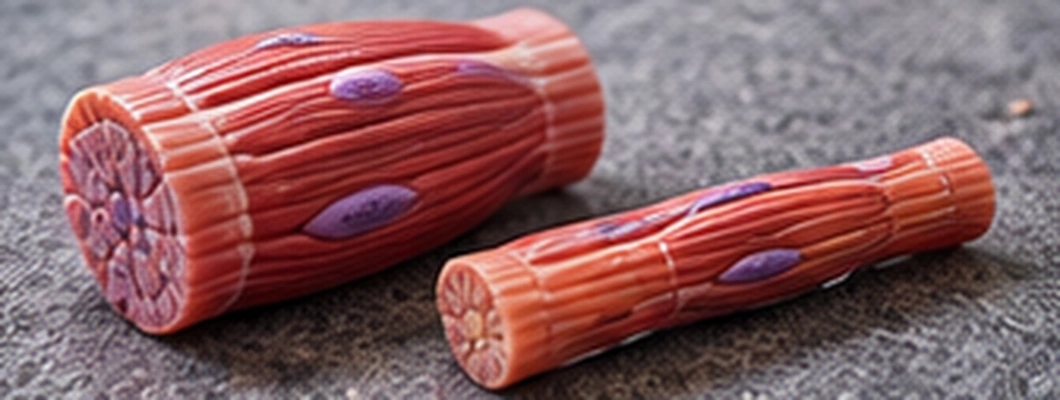
Muscle is made of long, thread-like cells called 'muscle fibers.' A cell holds a 'nucleus' containing the blueprint for making proteins. Most cells have one nucleus, but a muscle fiber has many, and these are called 'myonuclei.'

When muscle grows
Myonuclei increase too
Outside each muscle fiber sit resting cells called 'satellite cells.' When muscle grows, satellite cells merge into the fiber and add new myonuclei. Because the stretch of fiber each myonucleus looks after is thought to stay roughly the same, more myonuclei are added as the fiber gets thicker.

The first explanation
The added myonuclei stay
In rodent experiments, myonuclei gained while the muscle grew did not disappear even after the muscle later shrank a lot. Fibers that kept many myonuclei grew thicker faster when training resumed. This explanation sees the remaining myonuclei as the basis of muscle memory.
In humans
When muscle shrank a lot, myonuclei dropped too
The idea that myonuclei stay comes mainly from rodent experiments. In humans, myonuclei stayed during a few months off strength training, but when muscle shrank a lot from long bed rest or aging, myonuclei dropped as well. So muscle memory in humans is not explained by myonuclei alone.

The second explanation
Marks left on genes
Genes in the myonuclei carry small chemical marks that decide which genes get used. When people did strength training, these marks changed, and some of the changed marks remained even after a break returned the muscle to its original size. Researchers see this as another way muscle memory works.

Strength lasts longer
What the nerves learned
After a few months off, muscle size went back to where it was before training, but strength stayed higher than before training. Researchers see this remaining strength as the brain and nerves having learned how to drive the muscle. Muscle memory was originally explained by this kind of nerve learning.

When humans retrain
Comparing one side showed no difference
In human experiments where only one arm or leg was trained first, then rested for months, and then both sides were trained together, muscle growth during retraining was no different between the side trained before and the side trained for the first time. In an experiment that compared the same people's first training with their retraining over time, muscle grew more during retraining.

Common misconception
If muscles have memory, do they not shrink during a break?
They do shrink. When people new to exercise did 7 to 10 weeks of strength training and then rested for months, the muscle size they had gained shrank back to near pre-training levels. Muscle memory does not mean muscle is protected during a break; it refers to what happens when training resumes.

Summary
Muscle memory is about rebuilding
Muscle memory is the effect of a once-built muscle growing back faster when training resumes after a break, as shown in rodent experiments; in human experiments that trained one arm or leg first, there was no difference. During a break, muscle shrinks, and strength lasts longer than size. Related terms: sarcopenia, skeletal muscle mass, muscle fiber types (fast-twitch and slow-twitch).

The more you know, the more you grow.PHYSIQUE NEWS