Short answer
Strength mostly holds. With 3 weeks of training only the other arm, cast-arm strength rose 3%, while it fell 17% without training. Pooled across studies, though, the effect on muscle size was small.
Can training only the uninjured side protect muscle on the injured side?
'Train one side → the other side gets stronger' — does it work for a cast arm?
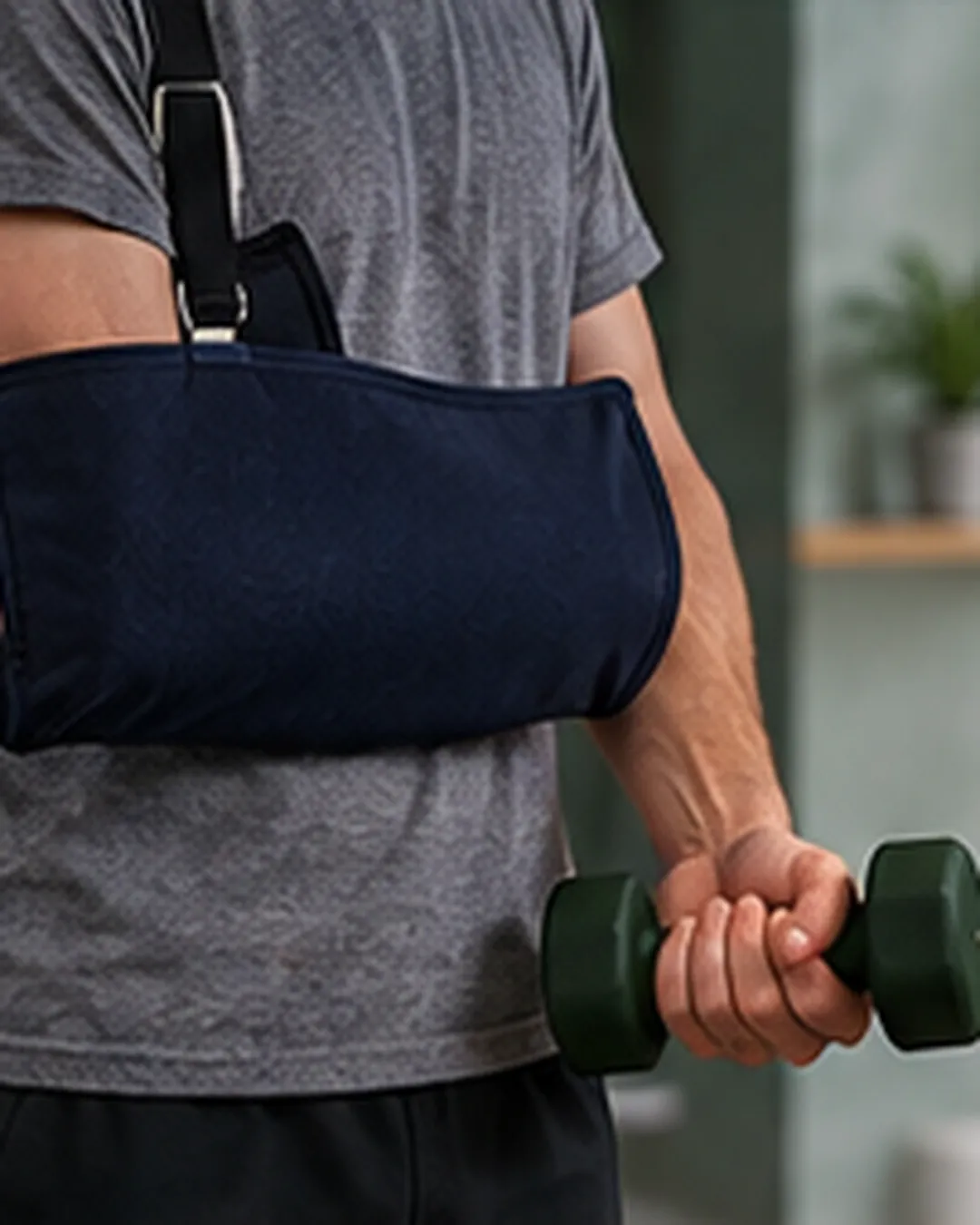
Training only one arm makes the other arm a bit stronger too. So can training the free arm protect an arm locked in a cast? We checked cast experiments and studies of real fractures and surgery.
With a cast alone
strength fell 17% and muscle size 12% in 3 weeks
36 people had one arm in a cast for 3 weeks. In the group that did no training, the cast arm lost 17% of its strength and 12% of its muscle size. In a 30-person study, the cast-only arm also lost both strength and muscle thickness over 3 weeks.
Training only the other arm
kept the cast arm's strength and size
In the same 36-person study, those who slowly lowered a dumbbell with the free arm in 6 sessions over 3 weeks saw cast-arm strength rise 3%, with size steady at 0.1%. In 16 people with a wrist cast for 4 weeks, strength fell only 2.4% with free-arm training versus 21.6% without.
The type of exercise mattered
Slow lowering protected best
In the 36-person study, the group that only lowered the dumbbell slowly saw cast-arm strength rise 3%. The group that only lifted it lost 4% of strength and 1.3% of size. Both lost far less than the no-training group (strength -17%, size -12%).
Pooling the studies
strength was clearly protected; the effect on size was small
A 2026 analysis pooling 8 studies and 189 people found free-arm training moderately limited strength loss in the cast arm. The effect on muscle size was small and showed up only when the elbow or shoulder was immobilized, not a distant joint like the wrist. The more the trained arm improved, the more the cast arm was protected.
In people with real injuries
strength came back faster early in recovery
Among 39 people with a broken wrist, those who trained the other hand had a grip of 17.3 kg in the injured hand at 12 weeks, versus 11.8 kg. By 26 weeks there was no difference. In a 42-person study, wrist strength was also higher on the day the cast came off. Pooling 5 studies after knee ligament surgery, thigh strength was better at 8-12 weeks.
Bottom line: training the other side protects strength
Protection of muscle size was only partial
Training only the other side kept cast-arm strength nearly intact, and after real fractures or surgery, strength returned faster early on. The effect on muscle size was small and seen only with elbow or shoulder immobilization. In the 36-person study, this came from 6 sessions over 3 weeks of 5 sets of 6 slow dumbbell lowerings.
A better body starts with a better question.PHYSIQUE NEWS