Short answer
Yes. Even with knee arthritis or pain at the front of the knee, strength training reduced pain and did not damage cartilage. Adjusting depth and weight to keep the pain tolerable is enough.
Is it okay to squat when your knee hurts?
'Knee pain → squats → cartilage wears down → more pain' — does this formula hold?
If your knee hurts, people tell you to quit squats first. The logic is that every bend wears down the cartilage and makes it worse. We checked pain, cartilage, weight and depth in turn.
Arthritic knees hurt less with exercise
139 trials, 12,468 people: 13 points less pain out of 100
A 2024 analysis that pooled 139 trials with 12,468 people with knee arthritis found those who exercised had pain scores 13.14 points lower out of 100 than those who did not. The type of exercise made no difference.
Pain at the front of the knee was the same
Exercise was named the first treatment
An analysis of 375 people with pain around the kneecap found exercise cut pain during activity by 1.46 more points out of 10. Adding hip exercises cut it by 2.20 points. A 2024 guide based on 65 trials with 3,796 people also named knee and hip exercise as the first treatment.
So does cartilage wear down?
9 trials using MRI: cartilage thickness held
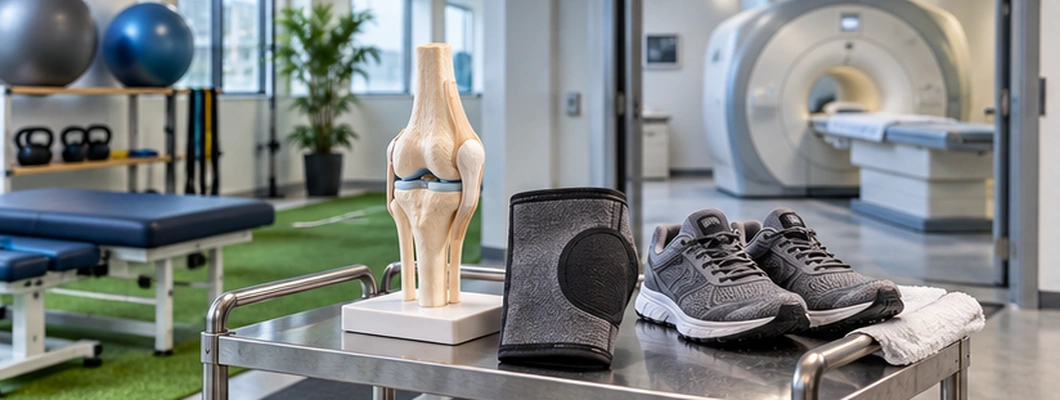
Researchers pooled 9 trials that used MRI to measure how weight-bearing knee exercise affects cartilage. In 6 comparisons of people with arthritis, there was no effect on cartilage thickness, volume or damage. They concluded this kind of exercise does not harm cartilage.
Lifting heavy did not make it hurt more
377 people, 18 months: pain 5.1 vs 4.9
377 people with knee arthritis spent 18 months doing heavy strength training, light strength training, or a control activity. Pain out of 20 was 5.1 in the heavy group and 4.9 in the control group, no difference. The squeezing force on the knee during walking was also the same.
Is it okay if it hurts a little?
7 trials, 385 people: painful exercise did fine
Researchers pooled 7 trials with 385 people comparing exercise that allowed pain with pain-free exercise. Allowing pain reduced pain slightly more in the short term, with no difference later. These trials allowed pain up to 5 out of 10 during exercise, settling by the next morning.
Depth and weight do raise the load, though
Deeper and heavier means more pressure behind the kneecap
An analysis of squats in 15 people found that bending the knee more and adding barbell weight raised the pressure behind the kneecap, peaking at 90 degrees. Kneeling or squatting at work 4 hours a day for 5 years raised arthritis risk 1.26 times. That is a very different dose from a few sets in the gym.
Bottom line: adjust, don't quit
The formula fails at 'squats → cartilage wears down'
Exercise reduced both arthritis pain and front-of-knee pain and did not wear down cartilage. Lifting heavy did not make it hurt more. If it hurts, reducing depth and weight to keep pain below 5 out of 10, and checking that it settles by the next morning, is enough.
A better body starts with a better question.PHYSIQUE NEWS