
Short answer
No. Human muscle grows because fibers get thicker. In 11 studies with training of up to 6 months, fiber number did not change, and bodybuilders had the same number of fibers as untrained people. Signs of new fibers showed up only in animals and in a few people who had trained for over 14 years or used steroids.
Do bodybuilders grow more muscle fibers?
'Thicker fibers' or 'more fibers'?
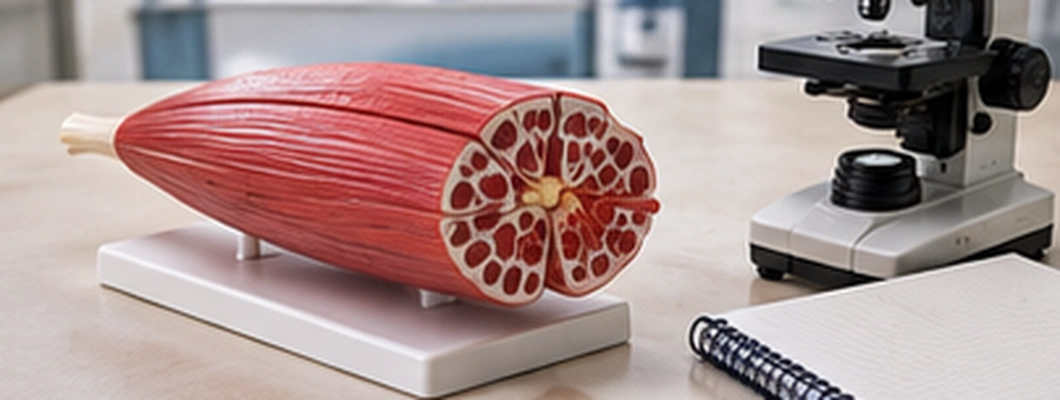
A muscle is a bundle of hundreds of thousands of thread-like fibers. It can grow in two ways: each fiber gets thicker, or the number of fibers goes up. We checked the research to see which one explains a bodybuilder's big muscles.
Animals did gain fibers
Across 17 studies, an average rise of 15%
An analysis that pooled 17 animal studies (360 animals) that loaded muscles with weights or exercise found fiber number rose by 15% on average. The method mattered. Keeping the muscle constantly stretched added about 21%, and exercise added about 12%.

And only after the fibers got thicker
In quail wings, fiber number rose only on day 28
Researchers hung weights of 10-35% of body weight, raised step by step, on one wing of 26 quail. By day 12, fiber thickness was up 111%, but fiber number had not changed. Fiber number rose by 82% only on day 28. Fibers thickened first and multiplied only after nearing their limit.

What about human bodybuilders?
They had the same number of fibers as untrained people
Researchers estimated fiber number in the front upper-arm muscle (biceps) of 12 bodybuilders and 13 people who did not train. Muscle size differed a lot, but fiber number was the same. Fiber number varied more than 2-fold between people, from about 172,000 to 419,000, and the researchers attributed that to genetics, not training.

Counting before and after training
The muscle grew, the fiber count stayed put
After 12 people trained for 12 weeks, the cross-section of their biceps grew from 11.8 cm² to 13.3 cm². The fibers got thicker, and fiber number did not change. A 2026 analysis pooling 11 studies also found no change in fiber number with up to 6 months of training, regardless of training history, length, or muscle.

Where did signs of new fibers show up?
Only in 2 people who had trained for over 14 years
4 bodybuilders had much bigger limbs, yet each fiber was about as thick as in the comparison group. That means they had more fibers. A nerve test showed abnormally dense fibers only in the 2 who had trained for 14 years or more. The 2 who had trained for 4-6 years were normal.

Steroid users and 'split fibers'
Not new fibers, but badly healed damage
Powerlifters who used steroids had more markers of newly forming fibers. Fibers that looked split made up 1.2% vs 0.35% in the thigh, and 1.7% in both groups in the shoulder. Tracing them through serial slices showed these were not fibers splitting in two, but fibers that had regenerated poorly after damage.

Bottom line: fibers get thicker, not more numerous
A bodybuilder's fiber count is something they were born with
In animals, fiber number rose only after fibers had thickened. In humans, fiber number stayed the same with up to 6 months of training, and bodybuilders had the same count as untrained people. Signs of new fibers appeared only in 2 people with over 14 years of training and in steroid users.

A better body starts with a better question.PHYSIQUE NEWS