
Short answer
For muscle, it is better counted separately. When 31 people averaging 72 years old added 50 g a day of collagen alone, it did not raise muscle building, while the same amount of whey or pea protein raised it 9%. Calculated on a typical mixed diet, up to 36% of daily protein can be collagen without running short of essential amino acids.
Does collagen count toward your protein target for muscle?
'20 g of collagen = 20 g of protein': does the math work?
Collagen powder is listed as protein on the label, so many people count it toward their daily protein target. We checked whether collagen does the same job as other proteins when it comes to building muscle.
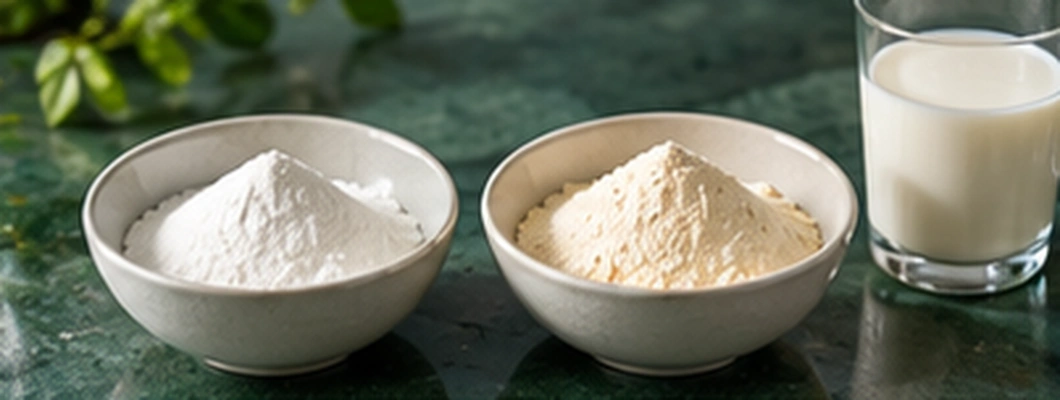
Collagen is missing an ingredient
It has no tryptophan, an essential amino acid
Collagen lacks tryptophan, one of the essential amino acids the body cannot make, so its protein quality score is 0. It is also low in leucine, which matters for muscle building. 35 g of collagen had 1.0 g of leucine, while the same amount of whey had 3.0 g.

Did it actually raise muscle building?
Whey and pea raised it 9%; collagen did not
31 people, average age 72, added 50 g of protein to a set diet for 8 days. With whey or pea protein, the rate of muscle building rose from 1.46 to 1.59, about 9%. With collagen it went from 1.43 to 1.46, with no difference.

Even with leucine matched, muscle grew less
10 weeks of training, thigh 8.4% vs 5.6%
22 people did strength training for 10 weeks while taking 35 g of whey or 35 g of collagen with added leucine to match. Thigh muscle thickness rose 8.4% vs 5.6% and the arm 10.1% vs 6.0%, more with whey. Strength and power showed no difference.

Returning to activity after a break
Only the whey side regained leg muscle
31 people in their late 60s got about 45% of their daily protein from whey or collagen while cutting calories for 3 weeks, and steps too for 2 of them. Both groups lost leg muscle, with no difference. In the 1 week back to normal activity, leg muscle and muscle building rose again only with whey.

What about the analysis that ranked collagen first?
Mostly an indirect result against a dummy drink
A 2026 analysis that pooled 78 studies with 4,755 people ranked collagen first among 13 proteins added to strength training. But the comparison was mostly a carbohydrate dummy drink, and only 1 trial put collagen directly against whey. Compared directly, as in the 22-person trial above, muscle grew more with whey.

Mixed in, essential amino acids did not run short
Up to 36% of daily protein still met essential amino acid needs
Calculated on a typical diet, replacing up to 36% of daily protein with collagen still met essential amino acid needs. When 28 people took 25 g of whey mixed with 5 g of collagen, muscle building was higher than with a dummy drink. When 22 people swapped 20 g of 45 g of whey for collagen, recovery and strength showed no difference.

Summary: count collagen separately for muscle
Fill the target with proteins like whey or pea that raised muscle building
Protein from collagen alone did not raise muscle building, and muscle grew less than with whey. If you eat 100 g of protein a day, up to 36 g can be collagen without running short of essential amino acids on paper. This calculation did not measure muscle growth. The muscle-building share is best filled with proteins like whey or pea that raised muscle building.

A better body starts with a better question.PHYSIQUE NEWS