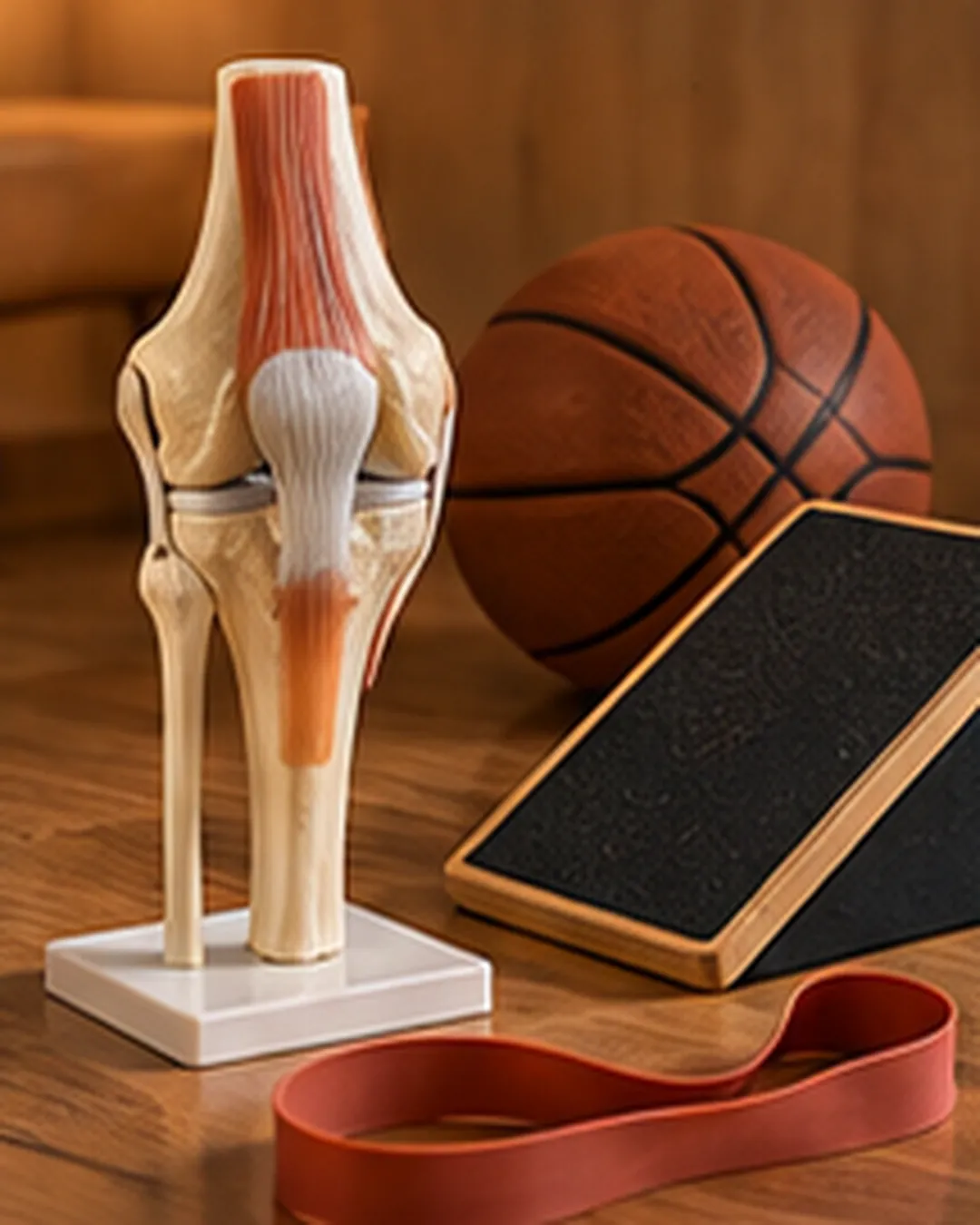
Short answer
Yes. People who did strength training had less than half the pain, did no worse than surgery, and 76% said they had recovered 5 years later. But 12 weeks of exercise added on top of full games and jumping did nothing.
Can exercise fix pain in the tendon below the kneecap (jumper's knee)?
'Rest is the only cure' — is that true?
Lots of jumping can make the tendon just below the kneecap hurt. People call it jumper's knee. We looked at whether it heals with rest, or whether loading the tendon is what helps.
Strength training hurt less
Pain was under half that of doing nothing
An analysis of 7 exercise trials (211 people) included a 39-person trial: pain in the strength-training group was 27 out of 100, versus 62 for those who did nothing. Resting alone hurt more.
It held up against surgery
No difference in scores over 12 months
35 people (40 knees) got either surgery or 12 weeks of decline-board squats. Over 12 months, symptom scores (out of 100) showed no difference, both rising from 30 to 70. In the exercise group, 5 of 20 knees moved on to surgery after 3-6 months.

Heavy, slow training lasted
After six months, injections slipped back and exercise held
39 people got a steroid injection, decline squats, or heavy, slow strength training for 12 weeks. All three improved by week 12. Six months later both exercise groups kept their gains, while the injection group got worse again. The heavy, slow group was the most satisfied.
But playing through the season changed things
The same squats did nothing for 12 weeks
29 people added decline squats for 12 weeks while still playing games and doing jump training in season. Their symptom score stayed put, from 71.1 to 70.2, no different from those who skipped the squats. They did only 59% of the planned exercise.
Stepping up the load worked better
Scores rose 28 points vs 18 after 24 weeks
76 people were split into two groups. One moved through stages, holds, then lifting, then jumping, then sport moves, guided by pain. Their symptom score rose 28 points after 24 weeks. The decline-squat-only group rose 18 points.
There was no magic method
Nothing beat heavy, slow strength training
An analysis comparing 10 trials (313 people) found no exercise beat heavy, slow strength training. Light weights with blood flow restricted by a cuff (36 people) gave similar results at 1 year. Static holds wiped out pain right away only in a 6-person study; in a 21-person study pain fell 0.9 out of 10, no different from regular lifting.
Bottom line: exercise helps, over months
76% said they had recovered 5 years later
58 people treated with exercise were surveyed 5 years later: 76% said they had recovered, and pain during sport fell from 7 to 2 out of 10. 71% got back to the sport they wanted. Read it this way: exercise that steps up the load over months is the path that works.
A better body starts with a better question.PHYSIQUE NEWS